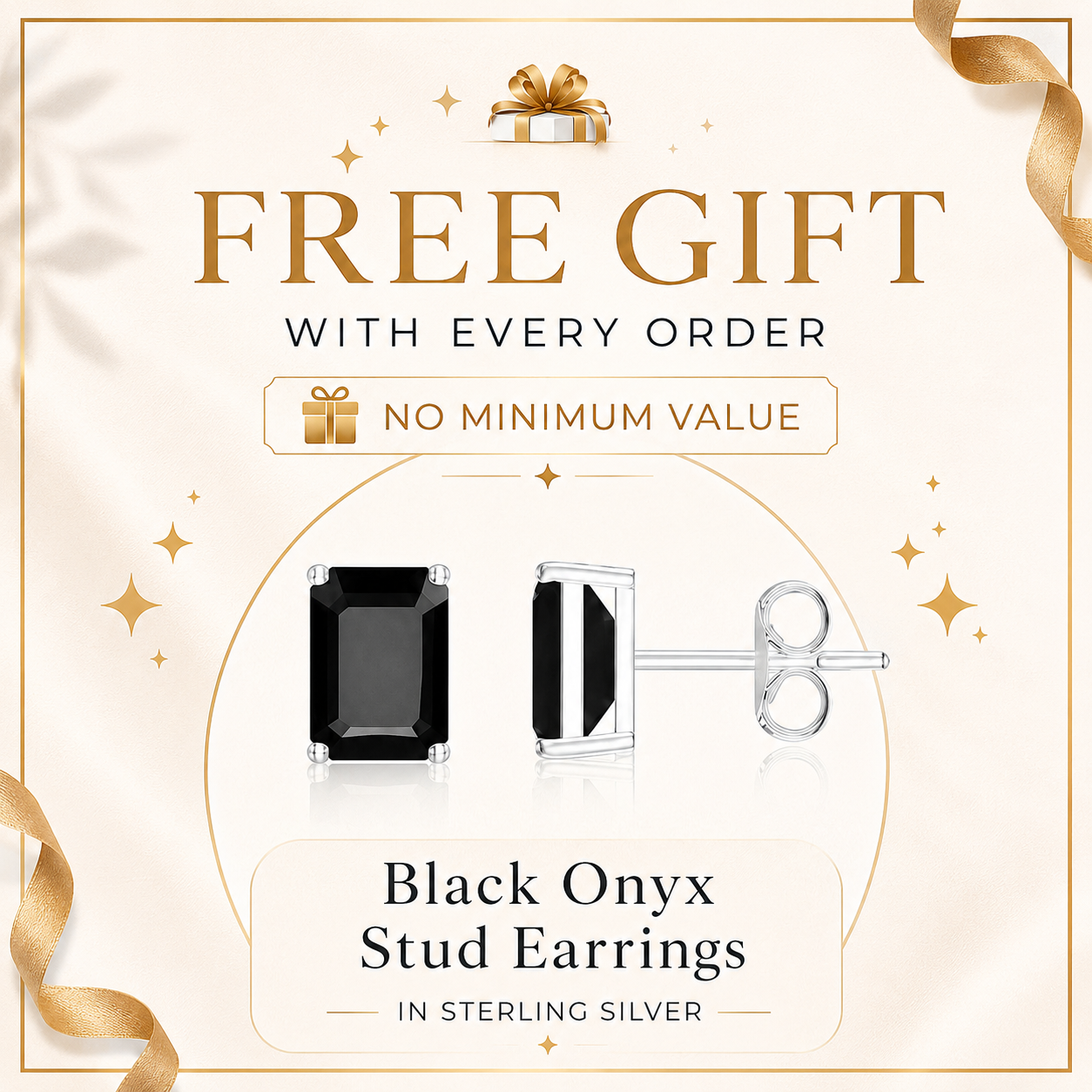
Get Black Onyx Silver Studs as a Free Gift on Every Order
Free Express Shipping | Free 30 Days Return
Get 10% Off on Your First Order
Trending Now
Popular Products

Cushion Cut Pink Sapphire Halo Engagement Ring with Moissanite Halo - 925 Sterling Silver
Discover timeless elegance with this exquisite cushion cut pink sapphire halo ring, a perfect blend of royal color and brilliant sparkle. The centerpiece features a stunning cushion cut pink sapphire in a rich, vibrant pink hue that captures light beautifully from every angle. Crafted...
- From $109.00
$126.00- From $109.00
- Unit price
- / per
Save $17.00
-
925 Sterling Silver
-
18K Yellow Gold Vermeil
-
18K Rose Gold Vermeil
-
18K White Gold Vermeil

Round Emerald Halo Engagement Ring with Moissanite Halo - 925 Sterling Silver
Discover timeless elegance with this exquisite round emerald halo ring, a perfect blend of royal color and brilliant sparkle. The centerpiece features a stunning round-cut amethyst in a rich, vibrant green hue that captures light beautifully from every angle. Crafted in lustrous sterling silver...
- From $109.00
$140.00- From $109.00
- Unit price
- / per
Save $31.00
-
925 Sterling Silver
-
18K Yellow Gold Vermeil
-
18K Rose Gold Vermeil
-
18K White Gold Vermeil

Cushion Cut Fire Opal Halo Engagement Ring with Moissanite Halo - 925 Sterling Silver
Discover timeless elegance with this exquisite cushion cut fire opal halo ring, a perfect blend of royal color and brilliant sparkle. The centerpiece features a stunning cushion cut fire opal in a rich, vibrant orange hue that captures light beautifully from every angle. Crafted...
- From $97.00
$112.00- From $97.00
- Unit price
- / per
Save $15.00
-
925 Sterling Silver
-
18K Yellow Gold Vermeil
-
18K Rose Gold Vermeil
-
18K White Gold Vermeil
Ring Size Guide
Topsy Jewels — Complete Guide
Ring Size Guide —
Find Your Perfect Fit
Everything you need to find your exact ring size at home — a full international size chart, step-by-step measurement methods, expert tips, and answers to the most common questions.
US sizes 3 – 13.5
US · UK · EU · Japan · Swiss
3 measurement methods
Expert tips & FAQs
Section 01 — Reference
International Ring Size Chart
All major sizing systems in one table — US/Canada, UK/Australia, EU/French, Japanese, and Swiss — with exact diameter and circumference in millimetres for every size. Highlighted rows are the most popular sizes for women in the US.
| US / Canada | Diameter (mm) | Circumference (mm) | UK / AU / NZ | EU / French | Japan | Swiss |
|---|---|---|---|---|---|---|
| 3 | 14.1 mm | 44.2 mm | F | 44 | 3 | 4 |
| 3.5 | 14.5 mm | 45.5 mm | G | 46 | 4 | 6 |
| 4 | 14.9 mm | 46.8 mm | H | 47 | 6 | 7 |
| 4.5 | 15.3 mm | 48.0 mm | I | 48 | 7 | 8 |
| 5 | 15.7 mm | 49.3 mm | J½ | 49 | 9 | 9 |
| 5.5 | 16.1 mm | 50.6 mm | K½ | 51 | 10 | 11 |
| 6 | 16.5 mm | 51.9 mm | L½ | 52 | 12 | 12 |
| 6.5 | 16.9 mm | 53.1 mm | N | 53 | 13 | 13 |
| 7 | 17.3 mm | 54.4 mm | N½ | 54 | 14 | 14 |
| 7.5 | 17.7 mm | 55.7 mm | O½ | 56 | 15 | 16 |
| 8 | 18.1 mm | 56.9 mm | P½ | 57 | 16 | 17 |
| 8.5 | 18.5 mm | 58.2 mm | Q½ | 58 | 17 | 18 |
| 9 | 18.9 mm | 59.5 mm | R½ | 60 | 18 | 20 |
| 9.5 | 19.4 mm | 60.8 mm | S½ | 61 | 19 | 21 |
| 10 | 19.8 mm | 62.1 mm | T½ | 62 | 20 | 22 |
| 10.5 | 20.2 mm | 63.4 mm | U½ | 64 | 21 | 24 |
| 11 | 20.6 mm | 64.6 mm | V | 65 | 22 | 25 |
| 11.5 | 21.0 mm | 65.9 mm | V½ | 66 | 23 | 26 |
| 12 | 21.4 mm | 67.2 mm | W½ | 67 | 24 | 27 |
| 12.5 | 21.8 mm | 68.5 mm | X½ | 69 | 25 | 29 |
| 13 | 22.2 mm | 69.7 mm | Z | 70 | 26 | 30 |
| 13.5 | 22.6 mm | 71.0 mm | Z+1 | 71 | 27 | 31 |
💡
Between two sizes? Always choose the larger size. A slightly loose ring is comfortable to wear and easy to resize. For wide bands (6mm or wider), go up half a US size from your normal measurement.
✦
Section 02 — Methods
How to Measure Your Ring Size
You do not need any special tools. Any of these three methods will give you an accurate size using items you already have at home. Method 1 is the quickest; Method 2 is the most precise if you own an existing ring that fits.
1
Easiest method — 2 minutes
The Paper Strip Method
Measure the circumference of your finger using nothing more than a thin strip of paper and a ruler. This is the most common at-home sizing method and requires no special equipment.
- Cut a thin strip of paper approximately 10 cm long and 5 mm wide.
- Wrap it snugly around the base of the finger you plan to wear the ring on.
- Mark the exact point where the paper overlaps with a pen or pencil.
- Unwind the paper and lay it flat on a ruler.
- Measure the length in millimetres from the end to your mark. This is your circumference.
- Use the converter tool to find your ring size from this measurement.
📐 Pro tip: Repeat this 3 times and take the average. Paper can shift between measurements. Use non-stretchy paper — avoid tissue or soft paper that distorts under tension.
2
Most accurate at home
Measure an Existing Ring
If you already own a ring that fits the correct finger perfectly, you can measure its inner diameter with a ruler or digital calipers and convert it to a size directly — no finger wrapping needed.
- Place the ring face-down on a flat white surface in good light.
- Use a ruler with millimetre markings.
- Measure the straight-line distance across the inside opening of the ring — inner edge to inner edge at the widest point.
- This number in millimetres is your inner diameter. Look it up in the size chart above to find your size.
📐 Pro tip: Digital calipers give a reading to 0.1 mm and are far more accurate than a ruler. Both diameter and circumference values appear in the size chart above for easy matching.
3
Most reliable overall
Visit a Local Jeweler
The most accurate method of all. Any jeweler will measure your finger for free using a professional metal ring gauge set. It takes under one minute and eliminates all guesswork entirely.
- Visit any local jewelry store — no appointment is needed for a sizing.
- Ask them to size the specific finger on the specific hand you plan to wear the ring on.
- Ask for your size in both US size number and mm inner diameter — this makes it universally usable.
- Note your size and keep it somewhere accessible for future purchases.
🏪 Pro tip: Always ask for your size in both US number and mm diameter. This way you have a measurement that works with any jewelry store worldwide, not just US retailers.
Expert Fitting Tips
🕒
Measure in the afternoon
Fingers are smallest in the morning and largest in the evening. Mid-afternoon gives the most accurate average reading. Do not measure first thing when you wake up.
🌡️
Temperature changes your size
Cold hands are smaller; warm hands are larger. Always measure at room temperature with warm hands. If your hands are cold from being outside, wait 15 minutes before measuring.
⬆️
Between sizes? Always go larger
If your measurement falls between two sizes, order the larger one. A slightly loose ring is comfortable and easy to have adjusted. A ring that is too tight can be painful and may need to be cut off.
💍
Wide bands need a larger size
A 6 mm or wider band sits higher on the finger and feels tighter at the same size number. Go up half a US size from your usual measurement when ordering a wide band ring.
🦴
Large knuckles — measure both
Measure the base of your finger and the knuckle separately. If the difference is one size or less, order the larger. If more than one size apart, use a silicone ring adjuster at the base.
📐
Always measure three times
Take any paper strip measurement at least three times and use the average. A single measurement can be off by 1–2 mm if the paper shifts during wrapping.
🍔
Avoid measuring after meals or exercise
Salty food and physical activity both cause temporary swelling in the fingers. Measure at a calm, neutral time — not after a workout, a large meal, or a salty snack.
🤲
Measure the correct hand
Most people's dominant hand is slightly larger than the other. Measure the specific finger on the specific hand you intend to wear the ring on — never assume both sides match.
💎
Some rings cannot be resized
Eternity bands and rings with gemstones set all the way around often cannot be resized. Take extra care to get an accurate measurement before ordering these styles.
✦
Section 03 — Reference
Average Ring Sizes in the US
If you are buying a surprise gift and have no measurement to work from, these averages will get you close. Most jewelers sample rings in these sizes, so they are the easiest to try on and exchange if needed.
Average women's ring size
7
Diameter: 17.3 mm · Circumference: 54.4 mm
UK: N½ · EU: 54 · Japan: 14
Common women's range: US 5 – 8
UK: N½ · EU: 54 · Japan: 14
Common women's range: US 5 – 8
Average men's ring size
10
Diameter: 19.8 mm · Circumference: 62.1 mm
UK: T½ · EU: 62 · Japan: 20
Common men's range: US 8 – 13
UK: T½ · EU: 62 · Japan: 20
Common men's range: US 8 – 13
🎁
Buying a surprise gift? Order size 7 for women and size 10 for men as your starting point. Both sizes are extremely common, easy to exchange, and can be resized by any jeweler — usually at low or no cost on a first resize.
✦
Section 04 — Questions
Frequently Asked Questions
Quick answers to the sizing questions we hear most often — from international conversions to what to do when you fall between two sizes.
The average US women's ring size is 7 — inner diameter 17.3 mm, circumference 54.4 mm, UK size N½, EU 54. Most jewelers sample rings in size 7 for women. If buying as a surprise gift without a measurement, size 7 is the safest starting point and is the easiest to exchange or resize.
The average US men's ring size is 10 — inner diameter 19.8 mm, circumference 62.1 mm, UK size T½, EU 62. Men's sizes typically range from 8 to 13, with 9 to 11 being the most common. If buying a surprise gift, size 10 is the best default for most adult men.
US size 7 equals UK size N½ and EU size 54. The inner diameter is 17.3 mm and the circumference is 54.4 mm. You can find all equivalent sizes for every US size in the size chart at the top of this page, or use our dedicated Ring Size Converter tool for instant results.
Always choose the larger size. A ring that is slightly loose is comfortable to wear, easy to have professionally adjusted, and will not restrict blood flow. A ring that is too tight is painful, can cut into the skin, and in serious cases may need to be cut off by a jeweler or emergency services. When in doubt, size up.
Yes. For any ring with a band width of 6 mm or more, you should go up half a US size from your normal measurement. Wide bands sit higher on the finger and press against a wider surface area, which makes them feel tighter than a narrow band of the same numerical size. This is especially important for comfort-fit styles.
Not always. Most people's dominant hand is slightly larger than their non-dominant hand — sometimes by a full half size. Always measure the specific finger on the specific hand you intend to wear the ring on. Do not assume both sides are identical, especially if you have ever noticed a difference in ring comfort between hands.
Yes. Finger size changes gradually with age, weight fluctuation, pregnancy, certain medications, and even the season. Fingers tend to be slightly larger in summer due to heat and slightly smaller in winter. If you have not measured in several years, re-measure before placing an order — your size at 25 may not be the same at 35 or 45.
Most plain metal bands can be resized 1–2 sizes up or down by a professional jeweler at relatively low cost. However, some ring styles cannot be resized — these include eternity bands (gemstones set all the way around the band), rings made from titanium or tungsten, and some very intricate or engraved settings. Always confirm the resizing policy and options before purchasing, especially for gemstone-set designs.
Mid-afternoon is the best time. Fingers are at their smallest first thing in the morning and at their largest in the evening due to fluid accumulation during the day. Avoid measuring right after waking up, after intense physical exercise, after eating salty food, or when your hands are cold — all of these cause temporary and sometimes significant size changes that do not reflect your true average size.
Measure both the base of your finger and the knuckle separately. If the difference between the two readings is one size or less, order the larger size. If the difference is more than one full size, order a ring sized to fit over the knuckle — so it passes on and off comfortably — and then use a small silicone ring adjuster clip at the base to prevent the ring from spinning or sliding down. These clips are inexpensive and widely available.
Need to Convert a Measurement?
Enter your diameter, circumference, US size, or UK letter into our dedicated converter and instantly see your size in every international system at once.
Open Ring Size Converter →- Choosing a selection results in a full page refresh.