Step into the Jazz Age. The Asscher cut, a square step cut with deeply clipped corners and a mesmerizing windmill of concentric facets, is the most distinctive silhouette of the Art Deco era and one of the most collectible cuts in all of jewelry. Look straight into an Asscher and you fall down a geometric rabbit hole of receding squares; jewelers call it the endless hallway. The Asscher-cut rings at Topsy Jewels revive this century-old glamour with genuine natural gemstones, handcrafted 925 sterling silver settings, and finishes of 18K yellow gold, rose gold, or white gold vermeil.
An Asscher does not glitter for everyone in the room; it performs a private show for the person looking into it. Its light moves in slow, deliberate flashes rather than constant sparkle, calm on the surface, hypnotic up close. If that idea appeals to you, read on: few cuts reward a closer look so generously.
Amsterdam, 1902: A Cut with a Name and a Date
Most cuts evolved anonymously over centuries; the Asscher was invented, patented, and signed. In 1902, master cutter Joseph Asscher of Amsterdam's famed Asscher family developed a square step cut with cropped corners, a high crown, and a small table, arranged so its facets spiral toward the center like a windmill. The family's prestige was such that in 1908 Joseph was entrusted with cleaving the Cullinan, the largest gem-quality rough ever found, whose pieces now sit in the British Crown Jewels. When Art Deco swept the 1920s, the Asscher's strict geometry made it the cut of the decade, worn with drop-waist dresses and platinum filigree. It faded mid-century, then roared back in the early 2000s as vintage style returned to fashion, and it has never really left since.
Depth, Poise, and the Octagonal Outline
Technically an octagon, the Asscher wears as a square with softened, beveled corners, a shape that sits with remarkable poise on the finger. Its high crown gives the ring elegant vertical presence rather than spread, so an Asscher feels intimate and architectural instead of flashy. The cropped corners eliminate fragile points, making the cut surprisingly practical for frequent wear. Hands with longer fingers showcase the square outline beautifully, while the compact footprint keeps the look proportionate on petite hands. The Asscher belongs to the same step-cut family as the rectangular silhouette in our emerald-cut rings collection; choose the emerald cut for elongation, the Asscher for concentrated symmetry. For the same square footprint with brilliant-style fire instead of calm steps, our princess-cut rings are the natural comparison.
Gemstones with the Clarity to Wear It
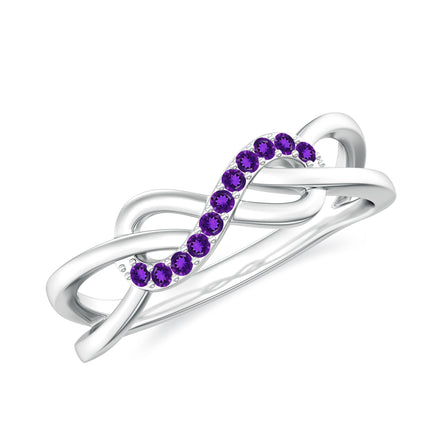
Step cuts are honest cuts: those wide, open facets display a gem's interior like a display case, so the Asscher favors stones with clean clarity and confident color. Aquamarine is a natural: its glassy transparency turns the windmill facets into pale blue infinity. Amethyst brings enough saturation to make each step glow violet, while citrine layers warm honey light down into the stone. London blue topaz gives the geometry a deep teal gravity, and morganite lends it a romantic Deco blush. White gold vermeil heightens the platinum-era mood of a blue or violet Asscher, while yellow gold vermeil evokes warm 1920s originals. For a bridal look with vintage backbone, an Asscher-cut moissanite offers step-cut serenity with superb hardness, a quietly spectacular alternative to convention. Many Topsy Jewels Asscher designs are available in several gemstone sizes, from discreet to distinctly dramatic.
Wearing the Deco Revival
An Asscher rewards intentional styling. A few principles keep the vintage magic intact:
- Keep settings architectural: four corner prongs or a fine bezel honor the cut's symmetry.
- Stack with slim geometric bands, milgrain or baguette-style, to build a period-correct look.
- Let one Asscher lead; this cut prefers being the single strong voice on the hand.
- Clean the table often; step cuts show fingerprints sooner than brilliants and reward a quick polish.
How to Recognize a Fine Asscher
Look straight down into the table and study the windmill: the four corner facets should converge on the center in crisp, symmetrical blades, and the concentric squares should recede evenly, like a hallway with no crooked doors. All eight sides of the octagonal outline should be balanced, with the corner cuts matching one another in width. Rock the stone slowly under a lamp; a fine Asscher blinks in ordered, alternating panels of light and shadow rather than random glitter. Cloudiness at the center or a muddled windmill means the proportions are off. Stones that keep their geometry honest are rarer than they sound, and they are the only ones this collection accepts.
A Connoisseur's Gift
Giving an Asscher-cut ring signals that you know jewelry. It suits the woman with strong aesthetic opinions, the vintage-fashion lover, the design-minded minimalist. As a proposal choice it is rare and memorable, our engagement rings collection includes step-cut styles for exactly such tastes, and it elevates anniversaries, milestone birthdays, Christmas, and Mother's Day beyond the expected. An Asscher-cut birthstone, aquamarine for March, amethyst for February, citrine for November, wraps personal meaning in century-old sophistication.
The Topsy Jewels Approach
Topsy Jewels makes storied design accessible. Every Asscher-cut ring here is handcrafted with a real natural gemstone, set in solid 925 sterling silver, and finished in 18K gold vermeil, affordable fine jewelry with genuine Deco soul, brightened where designs allow with moissanite accents. Care is simple and worth the ritual: remove the ring before water and housework, bathe it in warm soapy water with a soft brush, dry it completely, and store it in its own pouch so nothing mars those mirror-flat facets. Then wear it somewhere with good lighting and watch people lean in; an Asscher always draws the curious closer. To survey every silhouette in the studio, from round brilliance to stepped restraint, visit the complete Topsy Jewels rings collection, where a hundred years of cutting history waits on one page.